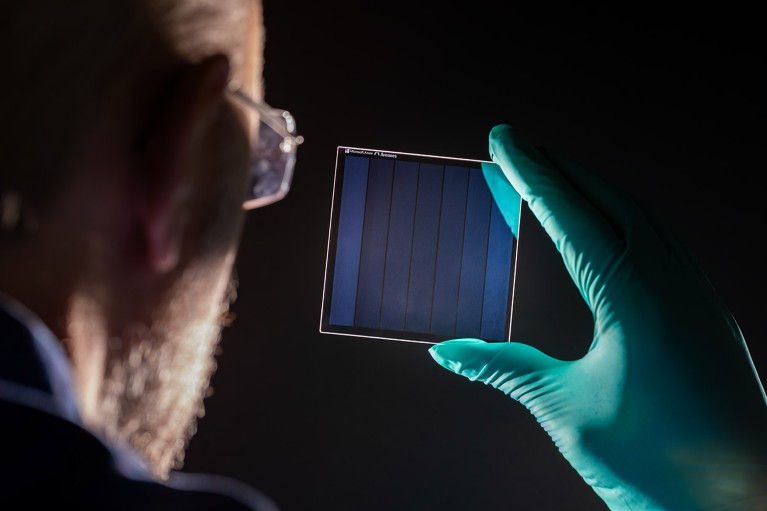
Microscoft’s glass storage method can store 4.8 terabytes of data.Credit: Microsoft Research
Researchers at Microsoft have created a data-storage system that can remain readable for at least 10,000 years — and probably much longer.
In the digital age, the need for data storage is ballooning. But current magnetic tapes and hard drives are ill-suited for long-term data storage because they degrade in about ten years. This “impressive” glass-based alternative could “in principle, act as near-permanent archival storage for backup of critical data,” says Mark Bathe, a biological engineer at the Massachusetts Institute of Technology in Cambridge.
The Microsoft team used a high-energy laser to imprint deformations into a 3D chunk of borosilicate glass, the kind used in ovenware. Each deformation encodes data that can be read out using a microscope.
A 12-centimetre wide, 2-millimetre-thick square of the glass can store 4.8 terabytes of data, the equivalent of around 2 million printed books, the authors demonstrate in their paper published in Nature on 18 February1.
Writing and reading the data is considerably more convoluted than opening a file on a hard drive, but the information is much more secure. Tests suggest that the data would survive for 10,000 years at a temperature of 290 ºC and potentially for tens or hundreds of times longer at room temperature, says Richard Black, a computer scientist who led the initiative known as Project Silica at Microsoft Research in Cambridge, UK.
Although the glass method requires specialist hardware to write and read data, the paper demonstrates that glass storage has gone beyond a materials experiment and is now a “deployable archival system”, says Long Qian, a computational synthetic biologist at Peking University in Beijing.
“By showing a complete system … they have shown how this technology can truly revolutionize the data-centre industry,” says Peter Kazansky, a researcher in optoelectronics at the University of Southampton, UK, and a previous collaborator with Microsoft on glass storage.
Nanoscale plasma explosions
Both magnetic tapes and hard drives encode data by using an electromagnet to magnetize tiny areas of a metal film in different orientations to represent 1s and 0s. But these tiny magnets can readily lose their magnetism, says Black, which means long-term storage requires regularly copying and re-writing the information. “The nice thing about the glass is, once it’s written, it’s immutable. You’re done,” he says. The storage for the device needs no temperature control or maintenance.
Kazansky and his colleagues developed the underlying physics behind laser-writing technology and still hold the Guinness World Record for the most durable digital storage medium for glass-based storage using fused silica. Microsoft began to build on their work in 2017. Although Kazansky’s approach maximizes durability and the density of data, in this latest work, Microsoft has gone for practicality. They explore a method that enables data to be written faster and decoded more reliably compared with Project Silica’s previous iterations, says Black, and it uses cheaper borosilicate glass rather than harder-to-make fused silica.
To encode information the team used a laser firing in intense bursts, a few quadrillionths of a second long, to zap the glass at precise points and with a specific amount of energy. At each point this creates a “plasma-induced nano explosion”, says Black, deforming the glass and changing how light travels through it. Researchers write the data using these tiny deformations, then read them out using a microscope that can pick up the shift in light’s behaviour as it passes through each point.
Enjoying our latest content?
Log in or create an account to continue
Access the most recent journalism from Nature’s award-winning team
Explore the latest features & opinion covering groundbreaking research
A top official at Chevron is warning that an upcoming vote by California state regulators could be the final straw that collapses the oil and gas industry in the state. The California Air Resources Board in May is expected to consider a proposal to update what’s known as the state’s “cap and invest” program. At…
Investors have gotten used to one thing in particular from Nvidia (NVDA 1.86%): blowout earnings reports. Thanks to the company’s position as the leader in the artificial intelligence (AI) chip market, it’s delivered positive earnings surprises and record numbers quarter after quarter. And the recent quarter wasn’t an exception. In Nvidia’s report after market close…
JavaScript is disabled in your browser. Please enable JavaScript to proceed. A required part of this site couldn’t load. This may be due to a browser extension, network issues, or browser settings. Please check your connection, disable any ad blockers, or try using a different browser.
The first four months of fiscal year 2026 got off to an expensive start for the U.S., according to the latest estimates from the Congressional Budget Office (CBO) . The CBO released a report yesterday detailing that, for the first third of FY26 (which began in October), the U.S. government operated at a deficit, and…
Traders work on the floor of the New York Stock Exchange on Dec. 11, 2025, in New York City. Spencer Platt | Getty Images This is CNBC’s Morning Squawk newsletter. Subscribe here to receive future editions in your inbox. Here are five key things investors need to know to start the trading day: 1. Cold front Rotation…
The surging cost of filling up her car is taking a toll on Melissa Miles’ finances — and her classroom attendance. A full-time student in social work at Eastern Michigan University, she commutes daily in her 2015 Chevrolet Sonic between school and her home 80 miles away in Hillsdale, Michigan. But with gasoline prices in…