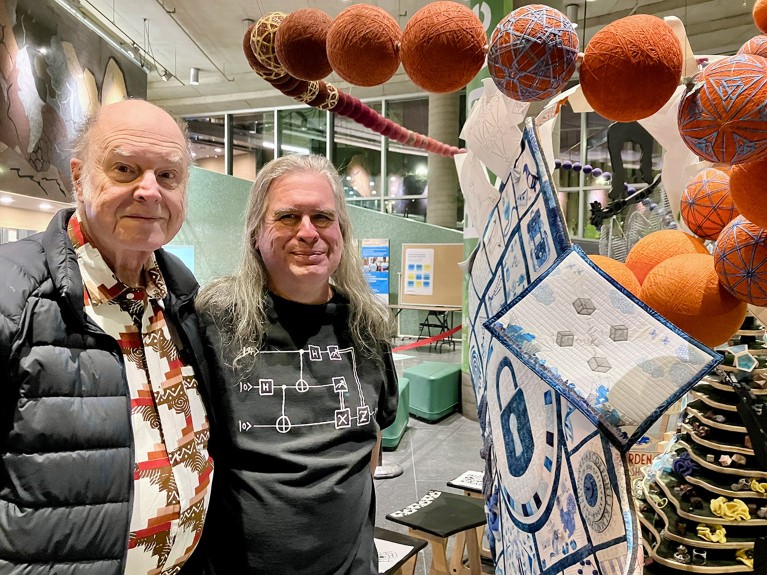
Charles Bennett (left) and Gilles Brassard pose for a photograph next to a cryptography quilt. Credit: Lise Raymond
Gilles Brassard and Charles Bennett have been awarded the A. M. Turing Award “for their essential role in establishing the foundations of quantum information science and transforming secure communication and computing”. The two will share the US$1-million prize, the Association for Computing Machinery in New York City announced on 18 March.
The two winners have seemingly unrelated research backgrounds: Brassard is a computer scientist at the University of Montreal in Canada, and Bennett is a physicist at IBM Research in Yorktown Heights in New York.
This is the first time that the Turing Award, often described as the most prestigious prize in computer science, has recognized work related to quantum physics. Bennett and Brassard — partly through joint work — began to investigate the power of phenomena that could go beyond what’s possible with non-quantum, or ‘classical’, methods of information technology as far back as the 1970s. “People thought it was just a little crazy,” says Bennett. “It didn’t occur to people that quantum effects could be used to do things that couldn’t be done classically.”
Brassard says the accolade made him “extremely happy”. “Had I been asked to choose one recognition at any point in my career, it would have been the Turing Award,” he says.
Bennett and Brassard “played a very big part in establishing the foundations of quantum information”, says Stephanie Wehner, a quantum-communications researcher at Delft University of Technology in the Netherlands. “Quantum information is more than a vehicle for classical information. We can do things with it that don’t have a classical analogue.”
Bennett and Brassard’s work not only initiated a whole field of technological development, but it also fed back into researchers’ understanding of the Universe, says Jonathan Oppenheim, a theoretical physicist at University College London. Bennett and others have used quantum information as a tool for investigating some of the most nagging problems about black holes, for example. “This whole revolution of quantum information theory is really bringing insights into the physical world,” Oppenheim says.
In 1984, Bennett and Brassard developed the first concept of a quantum encryption key1 — one that the sender of a message could share with the receiver in a stream of photons. They showed that any device trying to intercept that stream would destroy the information stored in the photons, thereby revealing that the transmission had been intercepted. Later that decade, Bennett led a team at IBM that first demonstrated technique experimentally.
Another breakthrough came in 1993. Starting from one of Bennett’s ideas, a team comprising Bennett, Brassard and four other researchers developed the concept of quantum teleportation2. It relies on the phenomenon of quantum entanglement, in which two particles share a quantum state even when moved far apart from each other. In teleportation, two entangled particles — one owned by a sender and the other by a receiver — can be used as a conduit to transport quantum information from the sender to the receiver.
Enjoying our latest content?
Log in or create an account to continue
Access the most recent journalism from Nature’s award-winning team
Explore the latest features & opinion covering groundbreaking research
Ray Dalio: I’ve studied 500 years of history and fear we’re entering the most dangerous phase of the ‘Big Cycle’ | Fortune A global macro investor for more than 50 years, Ray Dalio founded Bridgewater Associates out of his two-bedroom apartment in NYC and ran it for most of its 50 years, building it into…
Ventura Foods is recalling thousands of cases of salad dressings sold at retailers including Costco and Publix because the condiments could contain “foreign objects,” according to an alert from the Food and Drug Administration. More than 3,500 cases of different varieties of salad dressing could be contaminated by “black plastic planting material” in granulated onion, an ingredient…
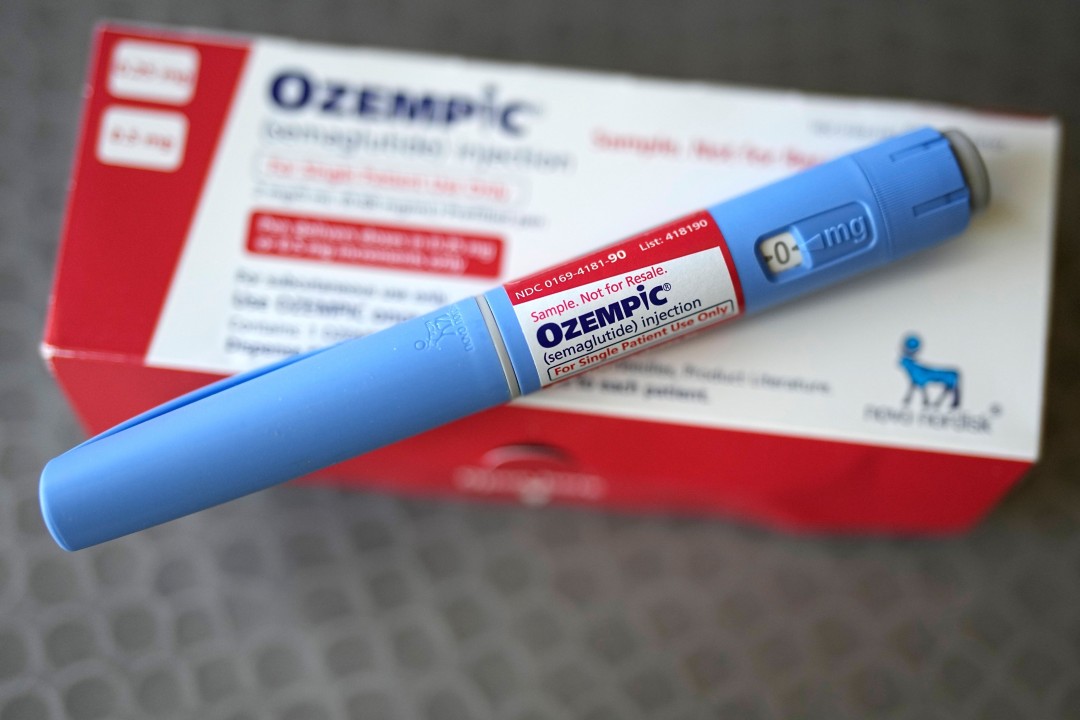
Novo Nordisk is planning a major markdown on two of the hottest drugs in medicine, though not for another year. The Danish drugmaker says it will cut the US list prices of its weight-loss shot Wegovy and diabetes drug Ozempic by up to 50%, bringing both to $675 a month starting Jan. 1, 2027, per…
Forward-Looking StatementsThis communication contains forward-looking statements that are inherently uncertain and difficult to predict, including statements regarding planned investments, anticipated business activities, the effect of conditions, and expected benefits of the expanded collaboration between Amazon and Anthropic, such as expected developments, performance, scaling, capabilities, customization, offerings, or impacts as a result of the collaboration; the…
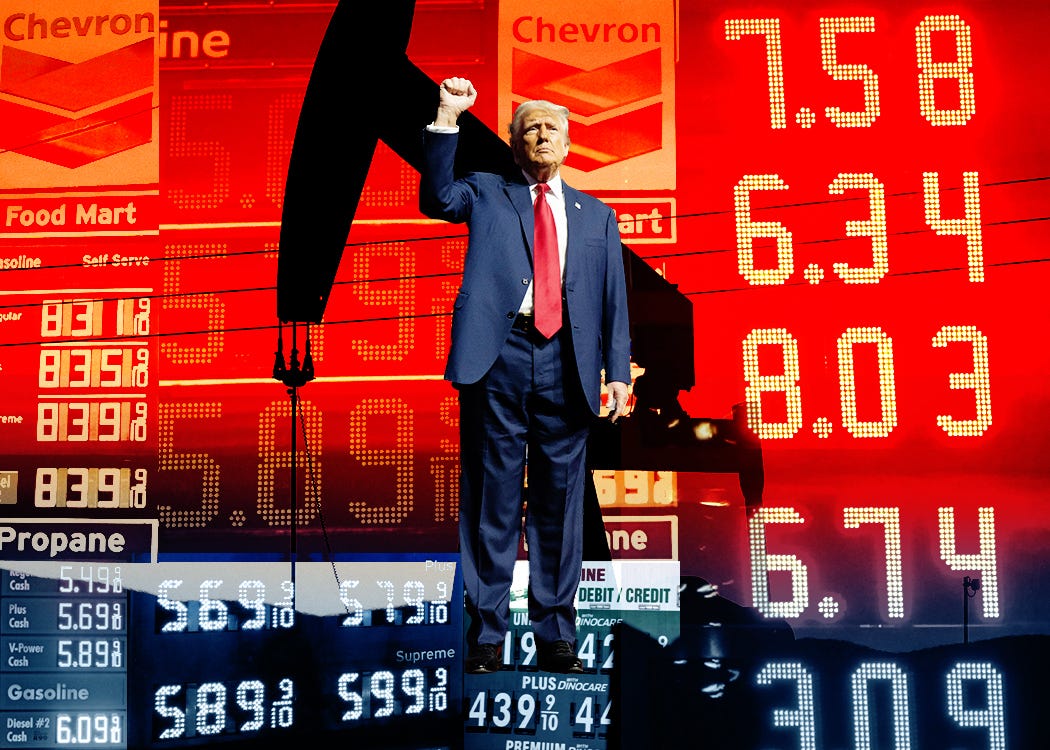
(Composite by Hannah Yoest / Photos: GettyImages / Shutterstock) NEON SIGNS ANNOUNCING the price of a gallon of gasoline are as ubiquitous a feature of America’s roadways as strip malls, cigarette butts, and roadkill. With so many gas stations competing with one another, each is eager to advertise a lower rate—especially since cheap fuel helps…