
Breaking Up With Everlane: Confessions of a Superfan – The Cut
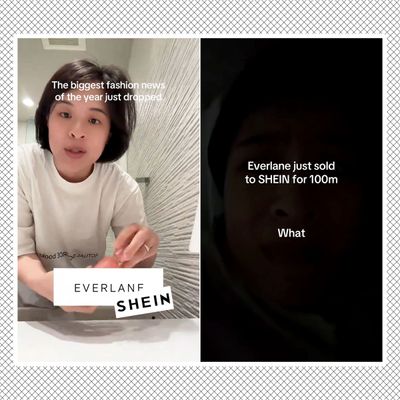
It’s official: Shein has purchased Everlane, one of the pioneers of what was once called “sustainable fashion.” (On May 17, Puck reported the going price was $100 million.) In its heyday, Everlane won over millennial shoppers with its affordable basics and commitment to what it referred to as “radical transparency” about its environmental impact and labor practices. For it to reportedly sell to a fast-fashion juggernaut was disappointing to many, to say the least. But Everlane had been changing long before this announcement. The founder and former CEO, Michael Preysman, stepped away in 2022 and was replaced briefly by Andrea O’Donnell and then by Alfred Chang in 2024.
When the Shein news dropped, a few people on TikTok said they ran to Crystal Chen’s account, Slow Buy Club, to get her take. On the account, Chen, a Bay Area resident who worked in marketing for two decades, educates followers about tricks companies use to make us buy more. The goal is to de-influence shoppers. Once a devout Everlane customer, she began sharing her disappointment with its declining quality on Slow Buy Club on April 2 to start a conversation on what we could learn from its downturn. In total, before the Shein news, she had posted three emotional videos about Everlane — the brand, she says in the videos, “broke my heart” — using her personal experience as a case study to discuss what being an ethical consumer really means.
I called Chen, who has never shopped at Shein and has sworn to boycott Everlane (she’s even blocked the website on her phone), to talk about falling in love and breaking up with the brand.
Around ten years ago, I bought my first piece from Everlane: a white silk shirt. Now they’d say the style fit the “clean girl” aesthetic, but we didn’t call it that back then. The piece suggested the woman wearing it understands what matters in life and doesn’t overcomplicate things. I was not a woman who had it figured out. I did tend to overcomplicate things.
At the time, Everlane was the uniform for tech workers and people who aspired to be tech workers. There was generally a mood of techno optimism circa 2016, and Everlane was a way to belong to that club. In fact, I wanted to belong so badly that I applied for a job at Everlane in 2015 and, when I didn’t get it, went to work for a competitor, Grana, instead. I worked there for a year.
The cherry on top of Everlane’s branding, which was not just a cherry but really the flavor of the entire cake, was this idea that it allowed you to be a “conscious consumer.” That it would audit its supply chain and publish its markups to show why it was pricing pieces the way it did and consumers would reward it for doing this. Around that time, brands like Reformation or Allbirds had the same value proposition (Reformation has since sold to private equity, and Allbirds is now an AI company). All these millennial labels were built on the contract of “You do the ethical heavy lifting, and we will buy into it.” Ten years later, the definition of conscious consumerism has changed.
At Grana, I realized that most products are made under very similar conditions to Everlane’s and a lot of what we believed to be differentiation around the brand’s ethics or materials was just marketing. I had an inkling that maybe this myth of being an ethical consumer didn’t exist, but I still held on — I threw myself into it. I bought Everlane’s whole lineup: the Arc Jean, the Utility Barrel Pant, the Utility Wide-Leg Pant, straight-leg jeans, a few dresses, and the Day Ballet Flat. With every new product-category drop, it was like rediscovering that “have it together” feeling. I thought, Once my wardrobe is all Everlane, it’s going to be complete. I spent about $2,000 to $3,000 at Everlane over the years, and that’s a conservative guess.
So were the clothes any good? When I first put on Everlane’s silk shirt, I honestly thought the material was quite thin. I think what happened was by the time I bought in, the brand had switched to a lighter-weight silk — either that or Everlane switched suppliers. It wasn’t the same shirt I had seen people in my circle wearing. I remembered feeling their shirts and being like, “This is amazing.” Every time I put the shirt on, I felt let down. I didn’t want to be wrong about buying it, but I didn’t feel good wearing it. Still, I had hope that it would work out someday. Nothing is wrong with the shirt. Something must be wrong with me and my expectations, I thought. I even bought the black one, thinking maybe the white was just too sheer. It ended up being the same. When I pulled the trigger on the Arc Jean, I didn’t realize how heavy it was. It looked very light and easy in the photographs. I blamed myself: Oh, Crystal, you should know better. I figured I didn’t know enough about materials science. And since I never went into debt, I didn’t realize I had a shopping problem.
One of the things with marketing is the final purchase that leads to the perfect self is always just one purchase away. That’s the treadmill we’re on. In 2025, I had my first kid, and the treadmill ramped up. I bought a lot of stuff postpartum, scrolling on my phone in the night while nursing. One of those nights, I was perusing Everlane’s website with my phone in a death grip and injured my wrist. That was when I knew I had a problem and needed to slow the fuck down.
My last purchase at Everlane was the Day Ballet Flat earlier this year. When I first bought them years ago, they were still made in Italy, but I’d worn those ones to shreds. I bought another pair, and they didn’t feel the same. I went to blame myself, but a little spidey sense sent me to its website to look at the supplier. The shoes were no longer made in Italy. I realized Everlane had moved the bulk of its popular style manufacturing to Vietnam at some point but was maybe still in contact with its old Italian suppliers and chose to continue labeling the shoes as “Made in Italy” to hike up the prices. I felt betrayed. I no longer doubted myself.
On social media, Everlane was doing too many influencer-style marketing videos. There were sales every weekend, and it all felt a bit desperate. I think every brand dreads the moment when it becomes desperate. That’s what tipped me over the edge — this was no longer the brand I fell in love with. Everlane had changed. Then, over the weekend, my friend texted me the news, saying, “Did you see this?” I had heard rumors that something big was in the works, so when the news hit, I wasn’t that surprised. My primary emotion was pity. I felt sorry for Everlane and all the people who, I’m sure, worked very hard to stop something like this from happening.
The irony is not lost on anyone: This brand that built itself on radical transparency just got bought by one that built itself on radical opacity, Shein. To watch Everlane, which we believed could be the antidote to fast fashion, succumb to it is a betrayal of so many of the bigger things we believed about how the world could be in 2016. The dream is over, and I’ve woken up. I am in my post-breakup reflection phase with Everlane. I was young, I believed, I was naïve, I was in love. I’ve learned my lesson, but it hurts, the realization that I had outsourced my values and my judgment to a brand.
Now I have my own playbook for how to shop with intention, how to buy slower, and how to resist marketing. I’ve entered into a new relationship with a different brand, which I don’t want to name because I try to deinfluence people from buying things online, but I’m smarter this time, and I have a prenup with higher standards in place. Still, when I was taking my kid out for a stroll recently and walked past the Everlane store, I felt the same feeling I used to have when I walked by an ex’s apartment building: What are they up to now?
Breaking Up With Everlane
Your product is saved! You’ll receive emails when your saved products go on sale. Manage preferences.





Comment