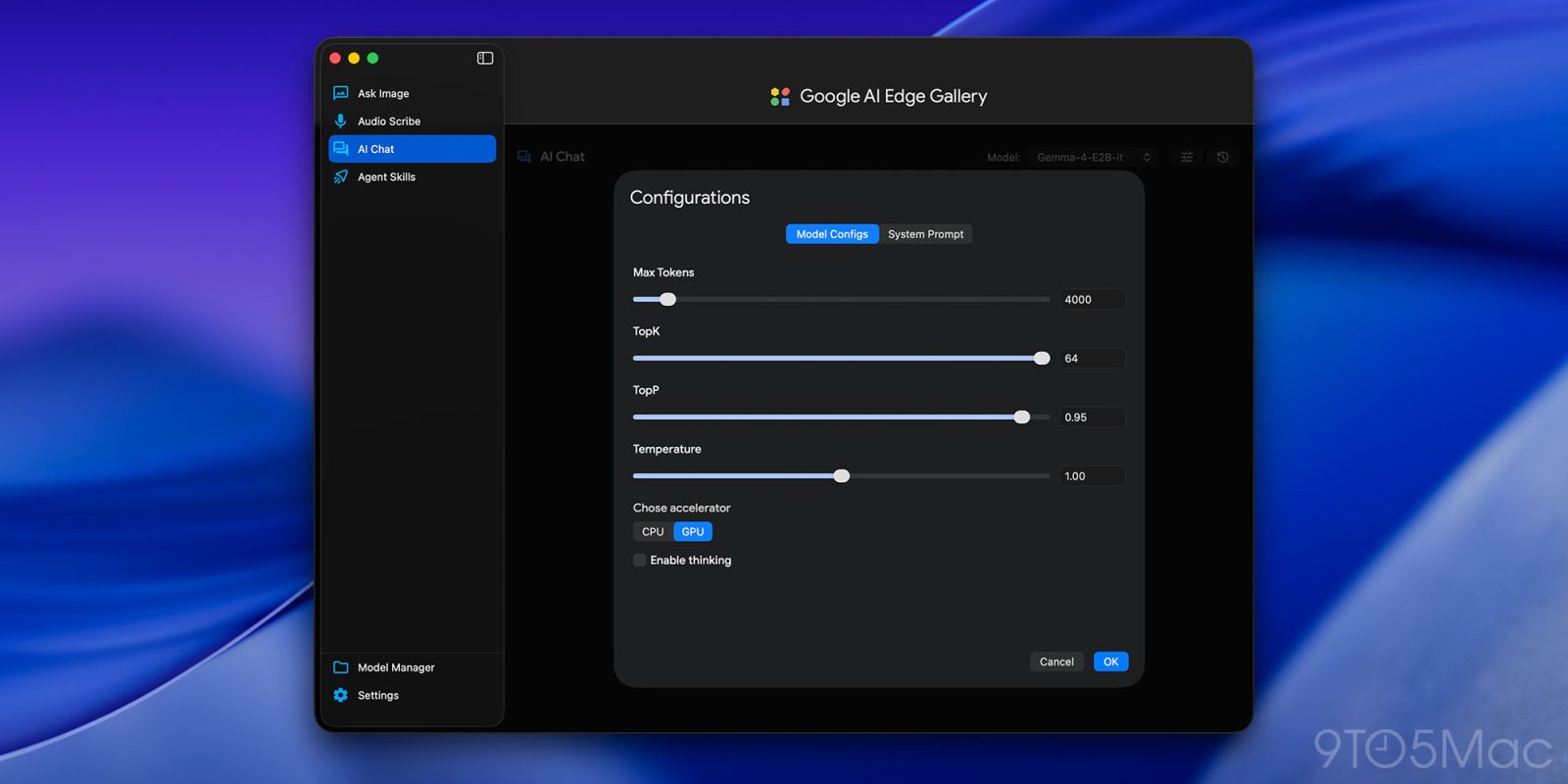
Google AI Edge Gallery launches on macOS, enabling local Gemini model usage for Mac users
In a significant advancement for artificial intelligence accessibility, Google has introduced the Google AI Edge Gallery, enabling users to run its Gemma AI models directly on their Macs. This development is part of a broader strategy to enhance local computing capabilities in AI applications, allowing for improved privacy and performance.
The release of the Gemma 4 12B model, alongside the Google AI Edge Eloquent dictation app for macOS, marks a pivotal moment in the evolving landscape of local AI solutions. Unlike traditional cloud-based large language models (LLMs), which many users interact with daily—typically via platforms such as ChatGPT and Claude—local models like Gemma 4 offer unique advantages. While these local models may not match the expansive capabilities of their cloud counterparts, they forgo reliance on an internet connection and provide enhanced privacy by processing data directly on the user’s device.
As users install local models, applications such as the Google AI Edge Gallery allow them to access a specific selection of advanced AI capabilities. Initially available for Android and iOS, the macOS version now features five proprietary models developed by Google. Among these, the Gemma 4 12B model stands out due to its ability to interpret instructions, enabling it to provide tailored responses rather than merely processing text.
The Gemma 4 12B model boasts a staggering 12 billion parameters, delivering performance comparable to more extensive models while remaining efficient enough for use on standard consumer laptops equipped with 16GB of RAM. This model is particularly notable for its multimodal capabilities, which enable it to process not only text but also visual and audio inputs. Furthermore, it exhibits strong coding capabilities, allowing users to derive actionable insights from their data locally.
In conjunction with these innovations, Google has launched the Google AI Edge Eloquent app, a free dictation tool designed to enhance the transcription experience. By processing user speech on-device, the app provides polished text outputs while offering customization options for various writing styles and terminology. This feature aims to reduce misinterpretations of specific words and jargons, addressing a common challenge faced by users of dictation technologies.
As tech enthusiasts and professionals explore these new tools, they represent Google’s commitment to enhancing AI accessibility and utility in everyday applications. The introduction of local AI solutions not only aligns with user demands for privacy and performance but also signifies a broader shift towards decentralized AI interactions.
#technology #business #entertainment