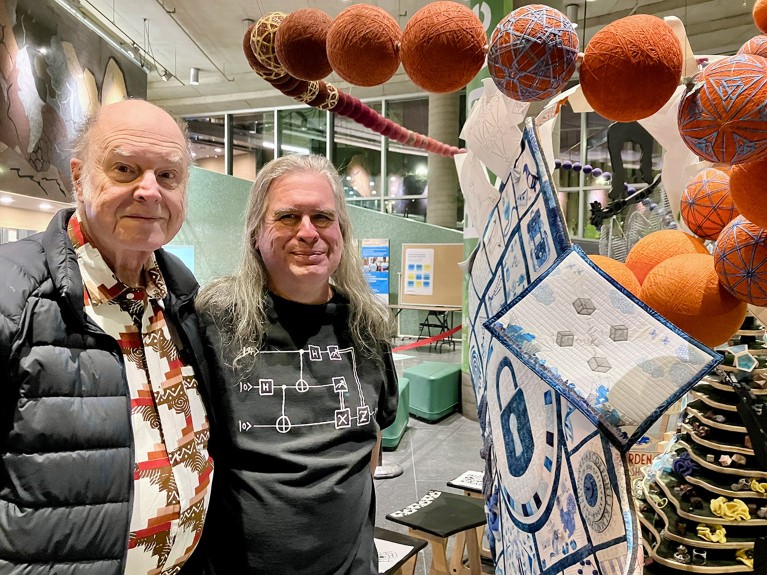
Charles Bennett (left) and Gilles Brassard pose for a photograph next to a cryptography quilt. Credit: Lise Raymond
Gilles Brassard and Charles Bennett have been awarded the A. M. Turing Award “for their essential role in establishing the foundations of quantum information science and transforming secure communication and computing”. The two will share the US$1-million prize, the Association for Computing Machinery in New York City announced on 18 March.
The two winners have seemingly unrelated research backgrounds: Brassard is a computer scientist at the University of Montreal in Canada, and Bennett is a physicist at IBM Research in Yorktown Heights in New York.
This is the first time that the Turing Award, often described as the most prestigious prize in computer science, has recognized work related to quantum physics. Bennett and Brassard — partly through joint work — began to investigate the power of phenomena that could go beyond what’s possible with non-quantum, or ‘classical’, methods of information technology as far back as the 1970s. “People thought it was just a little crazy,” says Bennett. “It didn’t occur to people that quantum effects could be used to do things that couldn’t be done classically.”
Brassard says the accolade made him “extremely happy”. “Had I been asked to choose one recognition at any point in my career, it would have been the Turing Award,” he says.
Bennett and Brassard “played a very big part in establishing the foundations of quantum information”, says Stephanie Wehner, a quantum-communications researcher at Delft University of Technology in the Netherlands. “Quantum information is more than a vehicle for classical information. We can do things with it that don’t have a classical analogue.”
Bennett and Brassard’s work not only initiated a whole field of technological development, but it also fed back into researchers’ understanding of the Universe, says Jonathan Oppenheim, a theoretical physicist at University College London. Bennett and others have used quantum information as a tool for investigating some of the most nagging problems about black holes, for example. “This whole revolution of quantum information theory is really bringing insights into the physical world,” Oppenheim says.
In 1984, Bennett and Brassard developed the first concept of a quantum encryption key1 — one that the sender of a message could share with the receiver in a stream of photons. They showed that any device trying to intercept that stream would destroy the information stored in the photons, thereby revealing that the transmission had been intercepted. Later that decade, Bennett led a team at IBM that first demonstrated technique experimentally.
Another breakthrough came in 1993. Starting from one of Bennett’s ideas, a team comprising Bennett, Brassard and four other researchers developed the concept of quantum teleportation2. It relies on the phenomenon of quantum entanglement, in which two particles share a quantum state even when moved far apart from each other. In teleportation, two entangled particles — one owned by a sender and the other by a receiver — can be used as a conduit to transport quantum information from the sender to the receiver.
Enjoying our latest content?
Log in or create an account to continue
Access the most recent journalism from Nature’s award-winning team
Explore the latest features & opinion covering groundbreaking research
Dear Annie: I previously worked with a woman, “Loretta,” who I’ve maintained a relationship with for over 20 years. We were never close, meeting-for-lunch type friends — more of a talk-once-a-month type. However, this changed when Loretta experienced financial difficulties, a marital separation and attempted suicide. She was hospitalized for two months and, as a…
Tesla saw an uptick in revenue and profit year-over-year, figures buoyed by an increase in automotive revenue and other services, including active subscriptions to its Full Self-Driving (Supervised) advanced driver assistance system, which reached 1.28 million. Tesla shares rose 4% in after-hours trading following the release of its first-quarter earnings report, driven largely by a…
Google is about to look really different, and if you’re not a fan of the AI Overviews feature, then you’re not going to like what’s coming. At the Google I/O 2026 keynote this week, the company announced that it is overhauling Search to embrace a conversational, AI-driven approach, even inviting users to enlist AI agents…
TOKYO (AP) — The packaging on some snacks in Japan is turning a somber black-and-white, as the war in Iran disrupts the supply of an ingredient used in colored ink. Tokyo-based Calbee Inc., which makes potato chips and cereal, said what’s inside remains the same. Calbee’s popular snacks are available in Japan’s ubiquitous convenience stores…
Reporting for this story was supported by a grant from the Fund for Investigative Journalism. TOM GREEN COUNTY, Texas—Some Texas oil wells gush hundreds of barrels of oil a day. But many are like the wells on Jackie Chesnutt’s ranch in West Texas that only trickle out a couple barrels a month. Chesnutt, a retired…