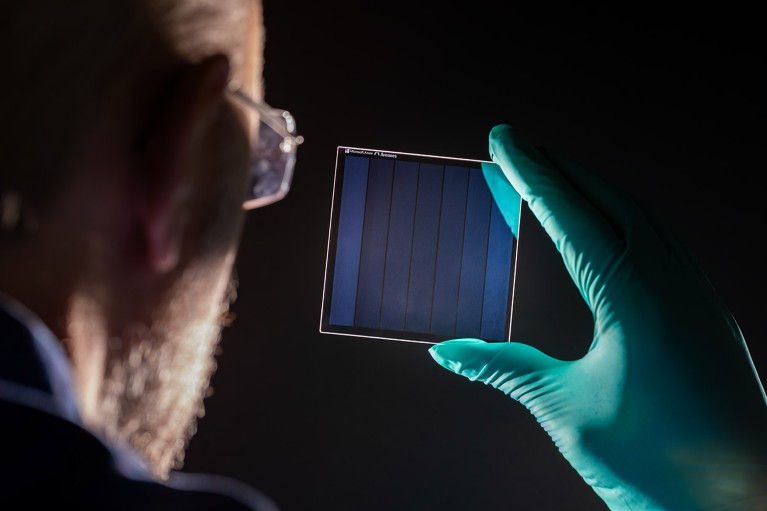
Microscoft’s glass storage method can store 4.8 terabytes of data.Credit: Microsoft Research
Researchers at Microsoft have created a data-storage system that can remain readable for at least 10,000 years — and probably much longer.
In the digital age, the need for data storage is ballooning. But current magnetic tapes and hard drives are ill-suited for long-term data storage because they degrade in about ten years. This “impressive” glass-based alternative could “in principle, act as near-permanent archival storage for backup of critical data,” says Mark Bathe, a biological engineer at the Massachusetts Institute of Technology in Cambridge.
The Microsoft team used a high-energy laser to imprint deformations into a 3D chunk of borosilicate glass, the kind used in ovenware. Each deformation encodes data that can be read out using a microscope.
A 12-centimetre wide, 2-millimetre-thick square of the glass can store 4.8 terabytes of data, the equivalent of around 2 million printed books, the authors demonstrate in their paper published in Nature on 18 February1.
Writing and reading the data is considerably more convoluted than opening a file on a hard drive, but the information is much more secure. Tests suggest that the data would survive for 10,000 years at a temperature of 290 ºC and potentially for tens or hundreds of times longer at room temperature, says Richard Black, a computer scientist who led the initiative known as Project Silica at Microsoft Research in Cambridge, UK.
Although the glass method requires specialist hardware to write and read data, the paper demonstrates that glass storage has gone beyond a materials experiment and is now a “deployable archival system”, says Long Qian, a computational synthetic biologist at Peking University in Beijing.
“By showing a complete system … they have shown how this technology can truly revolutionize the data-centre industry,” says Peter Kazansky, a researcher in optoelectronics at the University of Southampton, UK, and a previous collaborator with Microsoft on glass storage.
Nanoscale plasma explosions
Both magnetic tapes and hard drives encode data by using an electromagnet to magnetize tiny areas of a metal film in different orientations to represent 1s and 0s. But these tiny magnets can readily lose their magnetism, says Black, which means long-term storage requires regularly copying and re-writing the information. “The nice thing about the glass is, once it’s written, it’s immutable. You’re done,” he says. The storage for the device needs no temperature control or maintenance.
Kazansky and his colleagues developed the underlying physics behind laser-writing technology and still hold the Guinness World Record for the most durable digital storage medium for glass-based storage using fused silica. Microsoft began to build on their work in 2017. Although Kazansky’s approach maximizes durability and the density of data, in this latest work, Microsoft has gone for practicality. They explore a method that enables data to be written faster and decoded more reliably compared with Project Silica’s previous iterations, says Black, and it uses cheaper borosilicate glass rather than harder-to-make fused silica.
To encode information the team used a laser firing in intense bursts, a few quadrillionths of a second long, to zap the glass at precise points and with a specific amount of energy. At each point this creates a “plasma-induced nano explosion”, says Black, deforming the glass and changing how light travels through it. Researchers write the data using these tiny deformations, then read them out using a microscope that can pick up the shift in light’s behaviour as it passes through each point.
Enjoying our latest content?
Log in or create an account to continue
Access the most recent journalism from Nature’s award-winning team
Explore the latest features & opinion covering groundbreaking research
(Bloomberg) — China vowed to prevent the yuan’s exchange rate from overshooting, sending yet another clear signal of its intention to slow the currency’s appreciation. The People’s Bank of China said while it will maintain the exchange rate’s flexibility, it will strengthen efforts to guide expectations and guard against “overshooting risks” for the currency, according…
NEW YORK (AP) — Activists planned protests at more than two dozen Target stores around the United States on Wednesday to pressure the discount retailer into taking a public stand against the 5-week-old immigration crackdown in its home state of Minnesota. ICE Out Minnesota, a coalition of community groups, religious leaders, labor unions and other…
Topline Elon Musk publicly inquired about buying low-cost Irish airline Ryanair on Monday afternoon in a series of posts on X, his latest suggestion he may consider buying the struggling company. Key Facts Musk responded to a witty X post from the airline appearing to oppose adding Wi-Fi on planes, asking Ryanair, “How much would…
With the FCC looking to ban foreign-made routers, the big question is whether your device of choice will be removed from store shelves. A new report using Speedtest.net data identifies which brands will be affected most, based on their popularity in the US. Speedtest.net’s parent, Ookla, examined user-submitted data from January 2025 to last month…
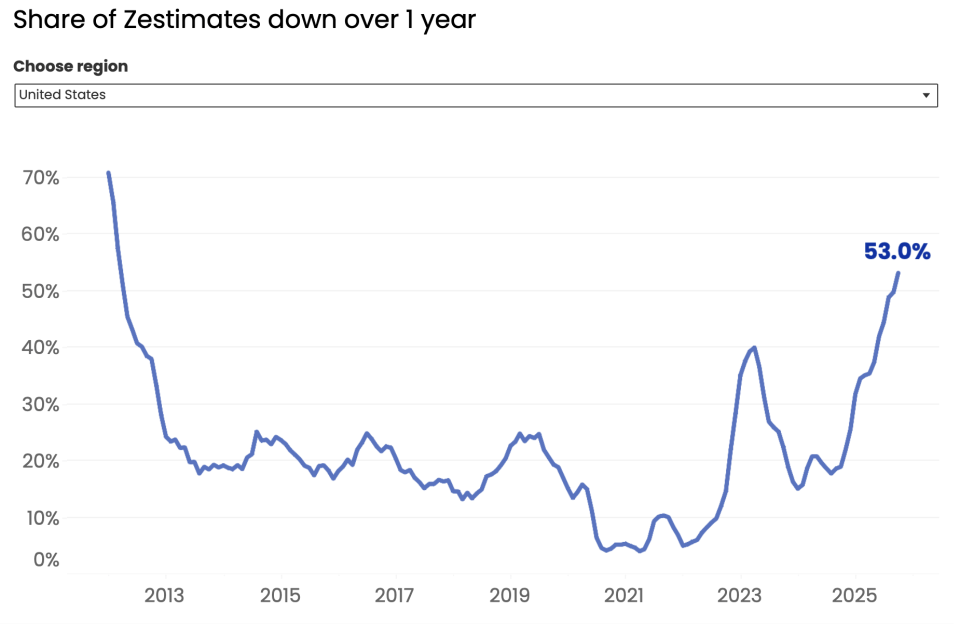
The share of U.S. homes that have lost value in the past year is the highest since the aftermath of the Great Recession, according to Zillow. In October, 53% of homes saw their “Zestimates” decline, the most since 2012 and up from just 16% a year earlier. Losses were most widespread in the West and South….
Discover which retail stores are open on Memorial Day and find out why post offices will be closed. Get all the essential information for your holiday plans.