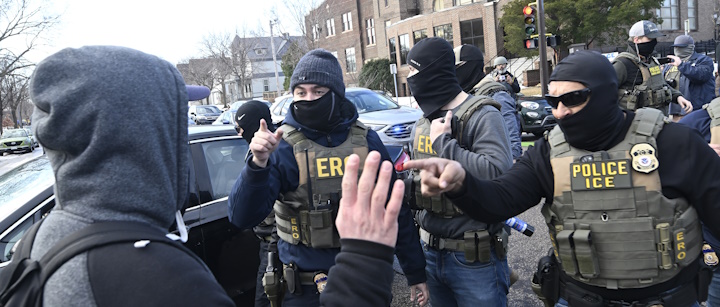
Minnesota Faces Upcoming Responses to ICE Actions as Trump Highlights Accountability and Retribution

In recent days, Minnesota has become a focal point of national attention as outrage continues to swell following the tragic shooting of a woman by an immigration agent. This incident has not only ignited widespread protests across the state but also elicited strong reactions from political leaders, including pointed comments from President Trump threatening a “day of reckoning.” The growing tension highlights an ongoing struggle over immigration enforcement and civil liberties, calling into question the balance between national security and the rights of individuals.
President Donald Trump has issued a stark warning to Minnesota, proclaiming that a “day of reckoning and retribution” is imminent as protests continue following the fatal shooting of Renee Nicole Good, a woman killed by an Immigration and Customs Enforcement (ICE) agent in Minneapolis. Trump’s assertion came through a lengthy message posted on his Truth Social account, where he refrained from providing specific details but underscored his administration’s commitment to a strong response.
This threat emerged in the wake of significant community unrest sparked by Good’s death. The Trump administration responded to the situation by announcing the deployment of hundreds more ICE agents to Minneapolis, a move that local leaders have criticized as an overreach that risks escalating tensions further. These federal agents already outnumber local law enforcement, which has raised alarms among city officials.
Trump’s comments reflect a broader narrative about immigration policies, as he accused the Biden administration of maintaining “horrible open borders” that allegedly allow undocumented individuals to thrive. His proclamation to “FEAR NOT, GREAT PEOPLE OF MINNESOTA” was subsequently echoed by the Department of Homeland Security, further intensifying pressure on the state.
Amid these events, Minnesota’s Attorney General filed a lawsuit against the Department of Homeland Security (DHS), asserting that the influx of immigration agents infringes upon residents’ constitutional rights and has led to “racial profiling, harassment, and chaos.” Reports have indicated that local schools are locking down and businesses are shuttering due to the unrest created by ICE operations, which the attorney general described as a federal “invasion” of the Twin Cities.
A wave of protests has gripped Minnesota post-Good’s killing, with many community members questioning the characterization of the incident by federal officials. Immediately following the shooting, the Trump administration labeled Good a “domestic terrorist,” asserting, without conclusive evidence, that the agent acted in self-defense against her vehicle.
However, videos circulating from the incident have led many to challenge that narrative, suggesting Good was attempting to escape rather than posing an immediate threat. The conduct of the ICE agents involved has also come under scrutiny, with local authorities expressing concern about the escalation leading to the tragic outcome.
In a striking move to maintain control over the investigation, the Federal Bureau of Investigation (FBI) intervened to prevent an independent state investigation from occurring, prompting further outcry from local leaders. Minneapolis Mayor Jacob Frey highlighted the possible implications for the investigation’s integrity given the federal response.
Adding to the international discourse, the United Nations Human Rights Council has called for a thorough and independent investigation into the circumstances surrounding Good’s death. The events surrounding this incident come against a backdrop of increased immigration enforcement in the state, particularly within the Somali-American community, which has faced aggressive scrutiny.
In a related development, the Trump administration recently announced the revocation of Temporary Protected Status (TPS) for Somalia, which had previously provided refuge for individuals facing dire conditions in their home country. This decision, communicated through USCIS, requires those under TPS to leave the United States by March 27, further complicating an already charged immigration environment.
#PoliticsNews #CultureNews