Volatility Spikes as Iran Diplomacy Collides With Hormuz Fears – Crude Oil Prices Today | OilPrice.com

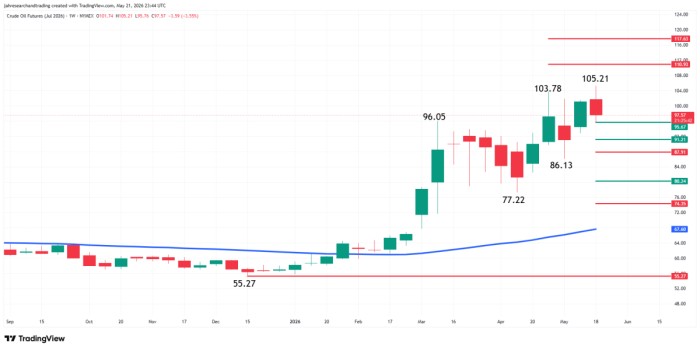
July WTI crude oil delivered a volatile week as traders aggressively repriced geopolitical risk and then rapidly removed part of that premium on hopes of a diplomatic breakthrough between the United States and Iran. Through Thursday, May 21, July WTI posted a high of $105.21, a low of $95.76, and settled at $97.77, up $3.39, or 3.35%, for the week.
The price action told a much bigger story than the weekly gain itself. Crude spent the early part of the week climbing sharply as traders focused on supply disruptions tied to Iran and the continuing blockage of the Strait of Hormuz. By Thursday, however, the market abruptly reversed course as traders shifted attention toward possible progress in negotiations between Tehran and the Trump administration. The nearly $10 weekly range reflected a market trading headlines rather than routine supply-and-demand data.
Iran Sends Prices Higher
Crude initially surged because traders viewed developments surrounding Iran as potentially threatening global oil supplies. Earlier on Thursday, prices gained more than 3% after reports indicated Iran’s Supreme Leader Ayatollah Mojtaba Khamenei had ordered enriched uranium to remain inside the country.
Markets viewed the move as potentially complicating negotiations with the United States because President Donald Trump has repeatedly identified dismantling Iran’s nuclear program as a primary objective. The possibility of stalled talks quickly raised fears that conflict risks…
July WTI crude oil delivered a volatile week as traders aggressively repriced geopolitical risk and then rapidly removed part of that premium on hopes of a diplomatic breakthrough between the United States and Iran. Through Thursday, May 21, July WTI posted a high of $105.21, a low of $95.76, and settled at $97.77, up $3.39, or 3.35%, for the week.
The price action told a much bigger story than the weekly gain itself. Crude spent the early part of the week climbing sharply as traders focused on supply disruptions tied to Iran and the continuing blockage of the Strait of Hormuz. By Thursday, however, the market abruptly reversed course as traders shifted attention toward possible progress in negotiations between Tehran and the Trump administration. The nearly $10 weekly range reflected a market trading headlines rather than routine supply-and-demand data.
Iran Sends Prices Higher
Crude initially surged because traders viewed developments surrounding Iran as potentially threatening global oil supplies. Earlier on Thursday, prices gained more than 3% after reports indicated Iran’s Supreme Leader Ayatollah Mojtaba Khamenei had ordered enriched uranium to remain inside the country.
Markets viewed the move as potentially complicating negotiations with the United States because President Donald Trump has repeatedly identified dismantling Iran’s nuclear program as a primary objective. The possibility of stalled talks quickly raised fears that conflict risks could rise again and keep Gulf supply routes under pressure.
The reaction showed that traders remain highly sensitive to any news suggesting reduced odds of a durable agreement.
Trump Flips Market Sentiment
The bullish tone changed dramatically later in the session.
Oil prices erased gains and moved sharply lower after investors focused on President Trump’s comments indicating diplomacy remained alive despite his increasingly firm rhetoric. Trump said he had delayed possible military action to allow additional time for negotiations and suggested he was willing to wait several more days before making further decisions.
Although Trump warned that Iran would eventually need to provide “100% good answers,” traders appeared to focus more heavily on the possibility that military escalation could still be avoided.
The market response was significant because traders had spent much of the week pricing in a larger geopolitical premium. Once hopes for negotiations improved, some of that premium rapidly disappeared.
Supply Risks Refuse to Disappear
Even with Thursday’s sharp reversal, the physical supply picture remains supportive.
Ship traffic through the Strait of Hormuz continues facing severe disruptions, keeping uncertainty elevated across global energy markets. The route remains one of the world’s most important oil transportation corridors, making any prolonged interruption difficult for traders to ignore.
The latest Energy Information Administration data also reinforced concerns surrounding supply tightness. U.S. crude inventories declined while exports remained strong and refinery utilization stayed elevated heading into the summer travel season.
Strong export demand and seasonal fuel consumption continue limiting the market’s ability to rebuild inventories.
IEA Issues Summer Warning
The International Energy Agency added another bullish consideration late in the week.
IEA chief Fatih Birol warned that global oil markets could enter a “red zone” during the summer if normal activity through Hormuz is not restored. The agency warned that rising seasonal demand combined with declining stockpiles could create increasingly tight market conditions.
Those comments likely prevented a larger selloff Thursday because they reminded traders that diplomacy alone will not immediately restore physical supply balances.
Weekly Light Crude Oil Futures
Trend Indicator Analysis
The main trend is up according to the weekly swing chart and moving average analysis. However, as of Thursday’s close, the market is positioned to post a potentially bearish closing price reversal top.
Despite the volatility the past two months, sellers have not been able to take out any significant bottoms, which is helping to keep the uptrend intact. Perhaps a confirmed topping pattern will be the catalyst that finally leads to a series of lower lows.
A trade through $105.21 will signal a resumption of the uptrend. A sustained trade under $86.13 will shift momentum to the downside.
The 52-week moving average is $67.61 and the nearest main bottom is at $55.27. Since these levels are not likely to be taken out over the near-term, the market will remain in “buy the dip” mode until the trend changes to down.
The short-term range is $86.13 to $105.21. The market is currently testing its pivot at $95.67.
The intermediate range is $77.22 to $105.21. Its retracement zone at $91.21 to $87.91 is the second layer of support for buy the dip traders.
The long-term range is $55.27 to $103.78. Its retracement zone at $80.24 to $74.35 is the last major support area before the 52-week moving average at $67.60. Inside this zone is the last main bottom at $77.22. This area will be very attractive to buyers if ever tested.
The potential support areas look more structured than the tops, which suggests a floor is forming that could provide support even after the war ends. The previous tops were all formed by speculative spikes that were gone in a flash. This suggests that trying to pick an eventual top will be a difficult task.
Weekly Technical Forecast
The direction of the Weekly July Crude Oil futures contract for the week ending May 29 is likely to be determined by trader reaction to $101.16.
Bullish Scenario
A sustained move above $101.16 will signal the presence of buyers. This move could create the upside momentum needed to break out over $105.21, with $110.93 the next objective.
Bearish Scenario
A sustained move under $101.16 will indicate the presence of sellers. This could create the downside pressure needed to retest the retracement zone at $91.21 to $87.91. If the selling is strong enough to take out the minor swing bottom at $86.13, then look for the weakness to extend into $80.24 to $74.35.
Outlook: Headlines Still Rule
Next week’s outlook remains tilted toward continued volatility.
A meaningful breakthrough in U.S.-Iran negotiations could remove additional geopolitical premium from crude prices and trigger another round of selling pressure. However, the market still faces unresolved supply disruptions, tight inventories, and warnings from the IEA regarding summer balances.
For now, the market appears caught between two powerful forces: diplomatic optimism and physical supply risk. The late-week selloff suggests traders are becoming more willing to price in potential peace, but until negotiations produce a definitive agreement and supply routes normalize, buyers are likely to continue emerging on sharp declines.
Technically, a close under $101.16 will form a potentially bearish closing price reversal top. If confirmed, this won’t change the trend, but it will indicate that the selling is greater than the buying at current price levels. This could trigger the start of a 2 to 3 week correction with $80.24 to $74.39 the main target.
<!–
Trending Discussions
–>