Breakthrough in Randomness Amplification Advances Experimental Techniques
Recent advancements in quantum information processing have revealed significant opportunities and challenges arising from computational errors common in quantum devices. As these devices are inherently imperfect, the necessity for effective quantum error correction becomes paramount. Additionally, random bit generation in these quantum systems exhibits flaws that must be addressed for practical applications, particularly in the realm of cryptography where high-quality randomness is essential for generating secure keys.
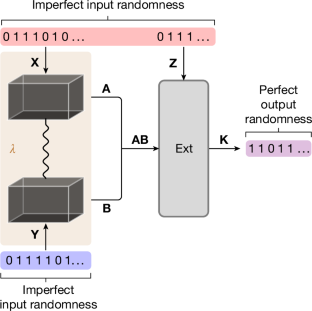
To tackle these issues, researchers have been exploring a method known as randomness amplification, which enhances the quality of random outputs derived from quantum devices. A recent experiment reported in a media source showcases a successful implementation of this protocol, achieving notable advancements in both theory and practice. The significance of randomness amplification is rooted in its device-independent nature—it does not rely on specific assumptions regarding the internal workings of quantum systems and requires a loophole-free Bell test to verify its effectiveness under controlled conditions.
Key to the experimental success were innovations that enabled a fine-tuned parameter regime, characterized by both strong Bell violation and high repetition rates. This has been made feasible by integrating theoretical developments with experimental capabilities utilizing superconducting circuits, marking a crucial step forward in quantum information technology.
Importantly, the results demonstrate a definitive quantum advantage: the experiment has confirmed that randomness amplification cannot be achieved through classical means alone. This breakthrough highlights not only the unique capabilities of quantum systems but also the potential for future applications, particularly in secure communications and cryptographic systems that can resist increasingly sophisticated threats.
As the field of quantum computing continues to evolve, the implications of random number generation and the ability to reliably amplify randomness are expected to play a critical role in securing digital communication channels. With this ongoing research paving the way, the future of secure quantum cryptography appears promising, offering robust solutions to the growing demand for data integrity in the digital age.
#technology #business