
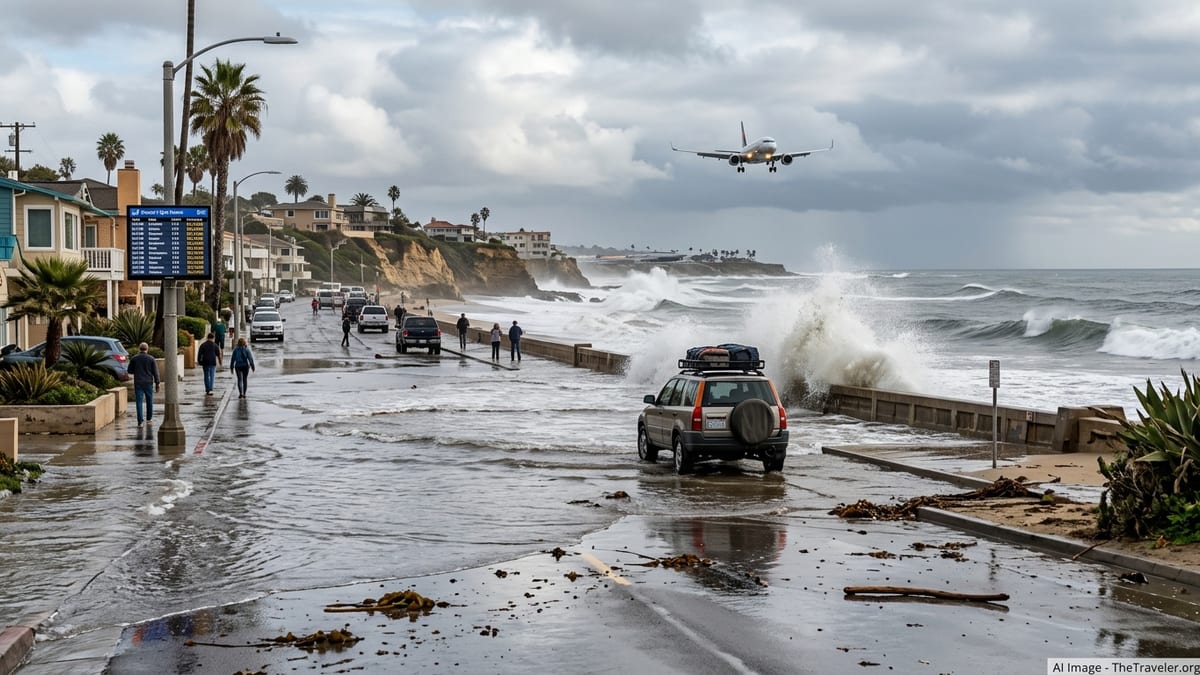
A strong coastal storm and record king tides disrupted Thanksgiving travel across the United States on November 26, 2026, affecting both the East and West Coasts. Hundreds of flights were delayed or canceled, and coastal roads experienced temporary flooding, prompting major U.S. airlines to expand weather waivers at busy travel hubs.
Coastal Storms and King Tides Impact Travel
The disruptions stemmed from two overlapping weather systems: a rapidly deepening low-pressure area moving along the East Coast and exceptionally high astronomical tides on the Pacific Coast, exacerbated by a strong El Niño. The National Weather Service had issued warnings about potential coastal flooding from Virginia to southern New England, coinciding with full-moon high tides.
By Thanksgiving morning, coastal flood warnings were in effect for various areas, including parts of the Mid-Atlantic shoreline and the tidal Chesapeake and Delaware bays. Local weather offices expressed concerns about multiple high-tide cycles, noting that strong easterly winds could hinder drainage, particularly in back bays and tidal rivers.
On the Pacific Coast, tide gauges in the San Francisco Bay Area recorded a new November record earlier that week, as king tides combined with elevated sea levels due to the El Niño. Forecasters warned of 20 to 30-foot surf along Northern California coastlines, leading to damage to oceanfront infrastructure and localized flooding in low-lying areas.
Emergency Declarations and Local Responses
On the Eastern Seaboard, the most severe flooding occurred in parts of New Jersey, Delaware, and Virginia. New Jersey issued a statewide emergency declaration on November 25, anticipating significant coastal flooding during high-tide cycles. Reports from southern New Jersey indicated that streets became temporarily impassable, isolating some residential neighborhoods until water levels receded.
Further south, communities near the lower Chesapeake Bay also faced flooding, consistent with earlier warnings from the Weather Prediction Center. Initial assessments indicated flooded basements, damaged docks, and localized erosion, along with scattered power outages due to strong winds and high water levels.
On the Pacific side, disruptions were caused by a mix of king tides, large surf, and heavy rain from incoming storm systems. California authorities had warned residents about potential flooding in low-lying waterfront districts leading up to Thanksgiving. Highway and transit agencies advised travelers to allow extra time due to minor flooding observed earlier in the week.
Travel Trends and Forecasts for Thanksgiving 2026
Federal aviation authorities noted that Thanksgiving 2026 was projected to be an unusually busy travel period, with over 81 million Americans expected to travel by road and air. The AAA and National Weather Service highlighted that 72.9 million Americans would be driving, facing a national gas average of USD 3.62 per gallon, significantly higher than the previous year.
As travelers navigated these conditions, the National Oceanic and Atmospheric Administration (NOAA) warned of coastal flooding and high winds as primary hazards along the Eastern Seaboard from Wednesday through Thanksgiving night. The situation was expected to evolve with the potential for a major nor’easter impacting the East Coast, while Pacific systems continued to create severe coastal hazards.
Background on Coastal Flooding and El Niño Effects
Coastal flooding can occur due to a combination of high tides, storm surges, and heavy rainfall, often exacerbated by climate phenomena such as El Niño, which can lead to warmer ocean temperatures and altered weather patterns. King tides are the highest tides of the year, resulting from the gravitational pull of the moon and sun, and can cause significant flooding in vulnerable coastal areas.


