
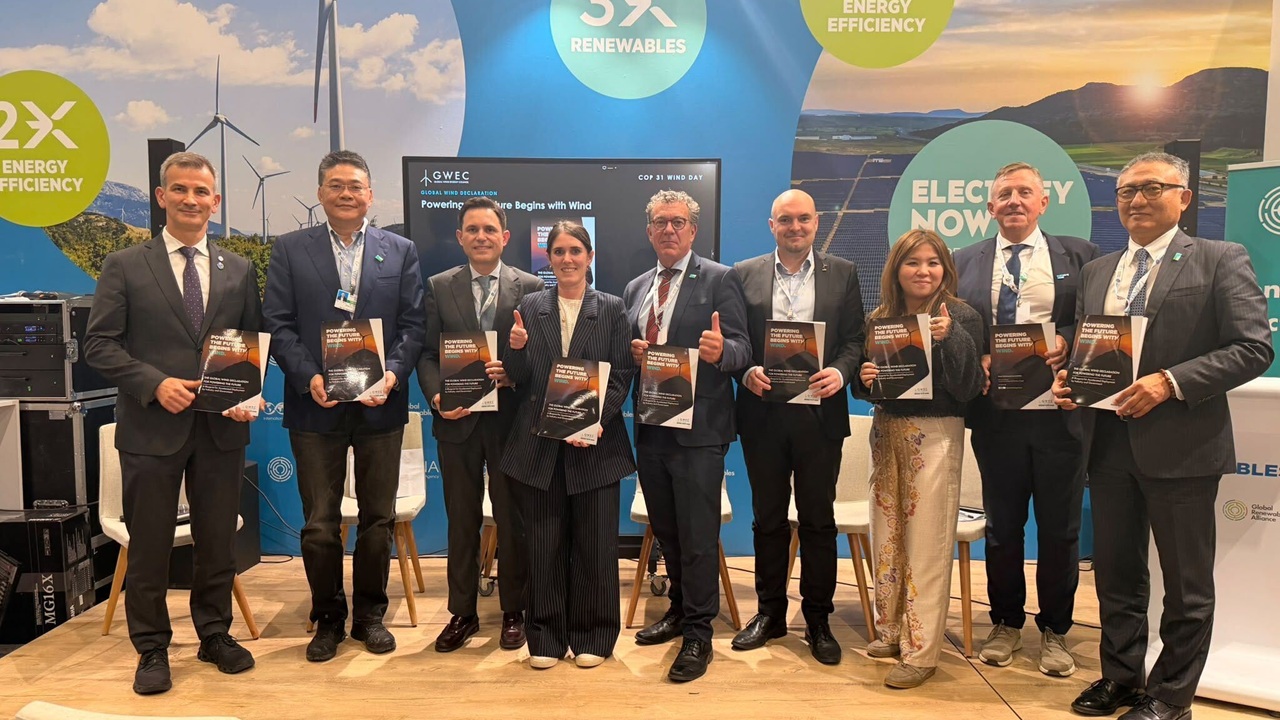
The global wind energy sector has introduced a new roadmap at COP31 in Turkey aimed at accelerating project development and achieving a capacity of 4 terawatts (TW) by 2035. This initiative, called the Global Wind Energy Declaration to Power the Future, is spearheaded by the Global Wind Energy Council (GWEC) in collaboration with the Turkish Wind Energy Association (TÜREB).
Global Wind Energy Council’s Goals for Expansion
The roadmap seeks to address barriers that hinder the development of new wind energy projects, particularly in areas such as permitting, financing, and supply chains. Ben Backwell, CEO of GWEC, emphasized the need for a more efficient permitting process, stating, “The transition to a clean, secure, and affordable energy system begins with wind power.” He noted that while constructing an offshore wind farm may take two years, obtaining the necessary permits should not take eight to twelve years.
According to GWEC, global wind power capacity reached 1,299 gigawatts (GW) by the end of 2025, having increased more than twentyfold over the past two decades. In 2025 alone, the sector added 165 GW of new capacity, enough to power an additional 118 million homes. The organization projects that with coordinated investments, wind power capacity could reach 2 TW by 2029 and 3 TW by 2035. If public support increases to reduce risks and facilitate investment, capacity could potentially exceed 4 TW by 2035.
Calls for Accelerated Renewable Energy Deployment
During COP31, United Nations Secretary-General António Guterres urged for a rapid acceleration of renewable energy initiatives, aiming to triple renewable capacity by 2035 compared to 2025 levels. The wind declaration outlines five principles to expedite implementation, including enhancing regulatory certainty, fostering regional wind industries, promoting innovation, and improving the integration of wind energy into existing electrical systems.
Michael Hannibal, president of GWEC, highlighted the industry’s growth, stating, “We have built an industry that today generates almost 1.3 TW of capacity globally, and just last year we added a record 165 GW.” He noted that the challenge moving forward will be to convert this industrial scale into new projects and secure sufficient investment to surpass the 4 TW target within the next decade.
İbrahim Erden, president of TÜREB, emphasized that achieving further advancements will require a combination of stable policies, efficient permitting processes, timely investments in infrastructure, and access to competitive financing. The declaration also stresses the importance of offshore wind development.
Rafael Munilla, business development director at Ocean Winds, stated that the sector is prepared to invest but needs “visibility and confidence” to turn potential projects into actual capacity. He pointed out that governments must create stable frameworks to facilitate investments.
The declaration also connects the need for accelerated renewable deployment to the rising demand for electricity driven by advancements in artificial intelligence and data centers, which are increasing pressure on energy infrastructure. GWEC proposes a shift from isolated project planning to integrated planning that encompasses generation, storage, and networks.
Kane Xu, senior vice president of Envision Energy, noted that the future growth of wind power will depend on not just improved turbine technology but also on effective integration with battery storage, smart grids, solar energy, and green hydrogen and ammonia.


